

by Ian Mann
March 06, 2026
/ LIVE
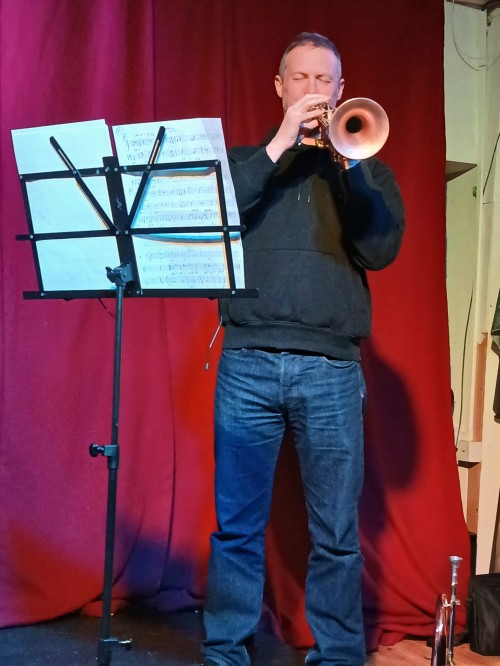
An excellent evening of adventurous music making with Williams rising to the challenge of the exposed and unforgiving musical setting of the trumpet trio.
Tomos Williams Trio, Brecon Jazz Club, The Muse Arts Centre, Brecon, 03/03/2026.
Tomos Williams – trumpet, Aidan Thorne – double bass, Matt Holmes – drums
Brecon Jazz Club’s March event represented a slightly delayed celebration of St. David’s Day and featured an unusually configured trio led by the Welsh trumpeter and composer Tomos Williams.
Williams has been a regular presence on the Jazz Mann web pages. With his saxophonist brother Daniel he co-leads the jazz/folk sextet Burum. This band’s albums “Caniadau” (2012), “Llef” (2016) and “Eneidiau” (2022) have all been reviewed elsewhere on this site, as has a live appearance at the 2014 Brecon Jazz Festival.
Williams is also a member of Khamira, which sees a quartet of Welsh jazz musicians, all of them associated with Burum, collaborating with a trio of Indian born musicians to create a unique musical and cultural hybrid of jazz, Indian classical music and Welsh folk. Khamira’s eponymous debut album (2017) and the follow up “Undod / Unity” (2022) are both favourably reviewed elsewhere on this site. As a paying customer I have also enjoyed live performances by the band on different tours at the Borough Theatre in Abergavenny and at the Chapter Arts Centre in Cardiff.
Williams also leads Seven Steps, a jazz quartet dedicated to exploring the music of Miles Davis. His other musical activities include his long term membership of the Welsh folk group Fernhill, and a duo with Welsh triple harpist Llio Rhydderch, with whom he recorded the album “Carn Ingli”.
Williams is currently working on a new project, Blodeugerdd / The Great Welsh Songbook, which will be featured at the 2026 Brecon Jazz Festival. The stellar line-up includes vocalist Eadyth Crawford, saxophonist Rachel Musson, pianist Huw Warren, bassist Paula Gardiner and drummer Mark O’ Connor, a real ‘who’s who’ of Welsh jazz. Blodeugerdd will appear at Theatr Brycheiniog at 4.00 pm on Friday 7th August 2026. Details here;
https://breconjazzfestival2026.co.uk/brecon-jazz-festival-theatr-brynheiniog/
Bur arguably Williams’ greatest musical achievements have come with his “Cwmwl Tystion” trilogy. The title “Cwmwl Tystion” (literally ‘a cloud of witnesses’) is originally Biblical in source and was derived from a poem by the Welsh poet, pacifist and nationalist Waldo Williams (1904-71) called “Beth yw Dyn?” (or “What is Man?”). Cwmwl Tystion has now effectively become a band name.
The Cwmwl Tystion project explores issues of Welsh history and identity and each stage of the project has been supported by the Arts Council of Wales and by the Cardiff based record label Ty Cerdd, an organisation devoted to supporting all forms of contemporary Welsh music.
“Witness”, the first jazz suite to be written by Williams under the Cwmwl Tystion banner toured Wales in 2019 and the subsequent live recording was released by Ty Cerdd in 2021. The music of the seven part suite celebrated the history, culture and landscape of Wales and asked questions regarding Welsh identity, both past and present. The first line up was comprised entirely of Welsh musicians and featured Williams on trumpet alongside Francesca Simmons (violin, saw), Rhodri Davies (harp, electronics) Huw Warren (piano), Huw V Williams (bass) and Mark O’Connor (drums). My review of the first Cwmwl Tystion album can be found here;
https://www.thejazzmann.com/reviews/review/cwmwl-tystion-witness
The second Cwmwl Tystion suite, “Riot!”, was a further examination of Welsh history and politics and again asked pertinent questions with regard to Welsh identity, drawing inspiration from moments of rebellion and civil unrest in Wales in both the 19th and 20th centuries. Like its predecessor it was a seven part suite but featured a very different line up with only Williams and O’Connor remaining from the first band. The new sextet featured two real heavyweights of the British jazz scene, saxophonist and spoken word artist Soweto Kinch and vibraphonist Orphy Robinson, with two Cardiff based musicians, vocalist Eadyth Crawford and tonight’s bassist Aidan Thorne completing the line up. The “Riot!” suite toured in late 2021 and the subsequent live recording was released by Ty Cerdd in 2023. Review here;
https://www.thejazzmann.com/reviews/review/cwmwl-tystion-ii-riot
“Empathy”, the final part of the trilogy, toured in 2024. This featured a truly international line up with Williams, Crawford and the faithful O’Connor joined by a second Welsh vocalist, Mared Williams, plus two real jazz heavyweights in the shapes of French / Vietnamese guitarist Nguyen Le and American electric bass specialist Melvin Gibbs. I was fortunate enough to witness a live performance of the suite, which again consisted of seven movements, at the Lost Arc venue in Rhayader. Review here;
https://www.thejazzmann.com/reviews/review/tomos-williams-cwmwl-tystion-iii-empathy-the-lost-arc-rhayader-powys-05-06-2024
Once again the concerts on the tour were recorded with a view to the release of a subsequent recording. “Cwmwl Tystion III – Empathy” will be released by Ty Cerdd on March 20th 2026 and I intend to review the recording in due course. My thanks to Tomos for providing with a review copy of the album when we spoke at tonight’s concert.
Tonight’s event was the first performance in a short Welsh tour that will see the trio also visiting Bangor, Rhayader, Newtown and Pembroke Dock. Although Williams and Thorne have worked together for many years in both the Burum and Cwmwl Tystion projects and Thorne and Holmes are regular collaborators it’s the first time that the band members have actually worked together as a trio, although Holmes has occasionally ‘depped’ for Mark O’Connor in some of Williams’ line-ups.
Thorne and Holmes teamed up with saxophonist Alex Clarke for a hugely enjoyable Brecon Jazz Club gig at The Muse in May 2025, a fascinating and hugely enjoyable performance that saw the rhythm team pushing Clarke out of her musical comfort zone as she rose magnificently to the challenge of playing in a chordless format. Review here;
https://www.thejazzmann.com/reviews/review/alex-clarke-trio-brecon-jazz-club-the-muse-arts-centre-brecon-27-05-2025
The programme that Williams and his colleagues have put together for this tour featured an intriguing mix of jazz standards, arrangements of Welsh folk tunes and a smattering of originals from both Thorne and Williams. With the exception of minimal amplification for Thorne’s bass the trio played entirely acoustically.
The trio eased themselves and their audience in relatively gently with a version of the Miles Davis composition “Solar”, ushered in by Thorne at the bass and subsequently featuring solos from both himself and Williams. Holmes moved from brushes to sticks as the music required and acted as an effective foil to the two soloists in addition to entering into an engaging dialogue with Thorne.. The level of interaction between the three musicians was high and Williams was quick to emphasise the collaborative nature of the trio, downplaying his role as leader. Indeed some of the dates on the tour have billed the trio as Williams / Thorne / Holmes.
Thorne’s original composition “Dreams” saw bass and drums establishing a fluid, rolling groove that provided the platform for Williams’ fluent and melodic trumpet soloing. The composer was also featured on double bass during the course of an excellent composition that saw the trio adopting a more contemporary style of jazz.
There’s plenty of precedents in jazz for the saxophone trio, most notably Sonny Rollins, and the sax / bass / drums axis remains a popular jazz format. The trumpet trio is seen much more rarely and when choosing material for this project Williams was influenced by the saxophone trios led by the American drummer and composer Paul Motian (1931 – 2011). From “Le Voyage”, Motian’s 1979 sax trio album for ECM Records, “Folk Song For Rosie” was a kind of abstract ballad introduced by Thorne at the bass and featuring Williams’ fragile trumpet melodies and Holmes’ subtle and delicate drum commentary, achieved via a combination of brushes, mallets and bare hands. Motian himself would have approved. Thorne and Williams were both featured as soloists , with the bassist briefly deploying the bow towards the close. Despite its avant garde inclinations this was a beautiful composition from Motian that elicited an equally beautiful performance from the trio.
Both Williams and Thorne like to improvise around Welsh folk tunes, with the Burum project setting the precedent for this. A sequence bearing the generic title “Farewell” commenced with the sounds of double bass and the patter of hand drums. Williams’ trumpet solo added stridency and urgency with Thorne’s bass the fulcrum of the performance. His bass motif underpinned Holmes’ drum feature before Williams’ melodic trumpet returned.
One contemporary trumpet trio that acts as a source of inspiration for Williams is the one led by New York based bassist and composer Linda May Han Oh, a group that also includes trumpeter Ambrose Akinmusire and drummer Tyshawn Sorey. Heavyweight company indeed, as Williams observed. From that trio’s album “Strange Heavens” the track “Noise Machinery” brought a touch of state of the art contemporary New York jazz to The Muse. Distinguished by its contemporary grooves and rhythmic urgency the performance included powerful solos from from Williams and Thorne. This was a piece that was very well received by the Brecon crowd with audience members expressing an interest in checking out Oh’s music.
As Williams reminded us 2026 represents the centenary of the birth of the late, great Miles Davis, Williams’ primary musical inspiration. With this in mind the trio rounded off a lengthy first set with a tune indelibly associated with Davis, “Seven Steps To Heaven”, actually written by Victor Feldman, the British born multi-instrumentalist and composer. The familiar theme prompted a fluent trumpet solo from Williams fuelled by Thorne’s propulsive bass lines and Holmes’ crisp drumming, with the latter enjoying his own feature towards the close as the first half ended on an energetic note.
During the interval Lynne Gornall of Brecon Jazz paid tribute to the memory of Dani Harris (1988-2026), the wife and manager of guitarist Remi Harris, whose funeral was due to be held at Wyre Forest Crematorium in Stourport-on -Severn the following day. The dress code for the funeral, which proved to be a real celebration of Dani’s brief but well lived life, was bright colours and Lynne urged everybody, whether attending the funeral or not, to dress colourfully the following day and to think of Dani.
Dani and Remi were great friends of Brecon Jazz Club and Remi was due to perform at The Muse just two days later as a guest of Mid Wales Rhythm & Blues Club performing his “Man Of The World Show”, a tribute to the late, great Peter Green.
Tomos Williams dedicated the first tune of the second set to Dani. The chosen piece was “Four”, another Miles Davis classic, with Williams sharing the features with Thorne and Holmes. The performance was also notable for the absorbing dialogue between Thorne and Holmes, two musicians who work together on a regular basis and who have established a particularly impressive rapport. This section was notable for virtuoso bassist Thorne deploying strumming techniques.
Thorne’s bowed bass ushered in his own composition “C”, which brought something of a ‘spiritual jazz’ feel to the trio’s repertoire. Williams contributed soft, breathy trumpet while Holmes added mallet rumbles to the highly atmospheric introduction. Thorne switched to the pizzicato technique and Holmes picked up his brushes as a more orthodox jazz groove was subsequently adopted, providing the platform for Williams’ trumpet soloing. Thorne’s bass then provided the grounding motif for Holmes’ drum feature, the bass eventually dropping out as the drummer continued alone.
An as yet untitled Williams original saw a vigorous, contemporary sounding bass and drum groove fuelling the solos of both Williams and Thorne.
Williams’ arrangement of the Welsh folk tune “Cob Malltraeth” was a celebration of one of the few beaches in Wales to face the east. If you hadn’t already worked it out it’s on the Isle of Anglesey, or Ynys Môn. Williams’ adaptation was commissioned by Mike Gould of the Ucheldre arts centre in Holyhead. Introduced by double bass and brushed drums the piece featured Williams’ melodic but emotive trumpet soloing, plus further features for Holmes at the kit and Thorne with the bow, another example of the bassist’s skill as an arco player.
The second set concluded with a composition that has become something of a contemporary jazz standard, “Beatrice”, written by American saxophonist Sam Rivers (1923 – 2011) and dedicated to his wife. Williams’ theme statement brought out the full beauty of Rivers’ melody and the performance also included features for both Thorne and Holmes.
The music of this adventurous trio was very well received by the discerning audience at the muse and the trio remained on stage to deliver a deserved encore, eventually settling on “Straight No Chaser” by Thelonious Monk. A lively, swinging rendition of the tune allowed for final features from all three band members as the trio signed off in style.
This had been an excellent evening of adventurous music making with Williams rising to the challenge of the exposed and unforgiving musical setting of the trumpet trio. He was given excellent and empathic support from Thorne and Holmes, both of whom who also shone in this spacious trio setting.
The trio’s chosen material was consistently interesting with group originals and bespoke arrangements of Welsh folk tunes rubbing shoulders with more familiar jazz standards. However the standards were treated to some highly adventurous interpretations, with Paul Motian’s rarely heard “Flok Song For Rosie” representing a particular highlight.
Amazingly it was Tomos Williams’ first visit to The Muse. One suspects that it will not be his last.
P.S.
I attended Remi Harris’ “Man Of The World” show on Friday 6th March, a superb high energy performance that drew a great response from a sell out crowd. It was a show that was notable both for the quality of the music and for the quality of the sound with Ian, the sound engineer at The Muse doing a brilliant job.
I attended the performance as a very satisfied paying customer but Jim Kerslake’s review, accompanied by Barry Hill’s superb photographs, can be found on the the Mid Wales Rhythm & Blues Club website.
http://midwalesrandb.club/2026/03/06/man-of-the-world-a-tribute-to-peter-green/
blog comments powered by Disqus