

by Ian Mann
August 01, 2026
/ ALBUM
Clowes continues to hone and develop the My Iris sound and the album compares well with former glories. A particularly well balanced quartet with a remarkable rapport developed over many years.
Trish Clowes
“Try Me”
(Stoney Lane Records SLR2012)
Trish Clowes – tenor & soprano saxophones, Chris Montague – guitar, Ross Stanley – Hammond organ, piano, Joel Barford – drums
Shrewsbury born saxophonist and composer Trish Clowes has been a regular presence on The Jazzmann web pages for sixteen years and the site includes reviews of her early albums “Tangent” (2010), “and in the night-time she is there” (2012) and “Pocket Compass” (2014), all released by Basho Records.
A former BBC Radio 3 New Generations Artist Clowes has a foot in both the jazz and classical music traditions and has co-ordinated seven editions of the boundary crossing Emulsion New Music Festival, presenting her brainchild at events in London, Birmingham and her native Shrewsbury. During her studies on the Jazz Course at the Royal Academy of Music Clowes regularly associated and played with students on the classical courses. Her recordings have often contained elements of both genres, with Clowes collaborating with a range of musicians drawn from both the jazz and classical fields. The Jazzmann site features coverage of the sixth and seventh Emulsion festivals which both took place in 2018 in Shrewsbury and Birmingham respectively.
Also featured is a 2015 performance by Clowes’ Emulsion Sinfonietta in conjunction with the electro-improvising duo Food, featuring saxophonist Iain Ballamy and drummer Thomas Stronen, that took place as part of that year’s Cheltenham Music Festival. This was more of a contemporary classical performance than a jazz one and on the whole I found it more difficult to engage with than Clowes’ regular jazz output. Nevertheless I have total respect and admiration for her willingness to experiment and challenge generic boundaries.
As a composer she has written regularly for both classical and jazz ensembles including Riot Ensemble, NDR Big Band, London Sinfonietta (, National Youth Orchestra of Great Britain and Orchestra of the Swan. Others with whom she has collaborated include the London Symphony Orchestra and the BBC Concert Orchestra.
Clowes has worked with composer Joe Cutler, playing on his saxophone concerto “Hawaii, Hawaii, Hawaii”, and with composer, vocalist and harpist Cevanne Horrocks-Hopayian, appearing on her debut album.
In 2024 Clowes and Ross Stanley, the latter specialising on piano, released the duo album “Journey to Where” for Stoney Lane Records, a recording that is reviewed elsewhere on this site.
Early 2026 then saw the release of “Colourfields”, a second duo album recorded with cellist Louise McMonagle, a regular Emulsion collaborator. This digital only release was also issued under the Stoney Lane imprint.
For the past decade Clowes’ primary creative project with regards to jazz has been her My Iris quartet featuring guitarist Chris Montague and keyboard player Ross Stanley, with the drum chair first occupied by James Maddren and more recently by Joel Barford.
Named for Clowes’ inspirational grandmother this group’s recordings include “My Iris” (Basho 2017), “Ninety Degrees Gravity” (Basho, 2019) and the digital only recordings “My Iris LIVE!” (Bandcamp, 2020) and “Wild Swimming” (Bandcamp, 2023). The two studio recordings have been reviewed elsewhere on this site, as have several live performances by the group at various venues in Clowes’ native Shrewsbury.
In 2018 My Iris supported a trio led by the Israeli bassist and composer Avishai Cohen at that year’s EFG London Jazz Festival. Playing to a huge crowd at The Barbican this show was a triumph for Clowes and the band and is reviewed as part of my Festival coverage.
Guest contributor Trevor Bannister also covered a 2021 livestream performance by My Iris from the Boileroom in Guildford during the pandemic.
In 2022 the third My Iris studio album “A View with a Room” was released on Greenleaf Records, the label of the great American trumpeter and composer Dave Douglas. It represented quite a ‘feather in the cap’ for Clowes to be selected to record for Douglas’ imprint and she was also invited to play some live performances with him. The “A View with a Room” album was arguably her strongest set to date and its music featured prominently in the My Iris live performance at The Hive in Shrewsbury in 2022.
Clowes’ latest release is a semi-conceptual work inspired by the urban land and river scapes of London, where Clowes now lives. In her “Notes on The Music” on the album cover she explains;
“On a cold January morning in 2025 I took a stroll along the Thames pathway from Rotherhithe to Blackfriars Bridge and made a collection of field recordings as I went. Everything you hear on this album started from these sounds. The compositions takes ideas from footsteps, bird calls, the distant sounds of buskers, cathedral bells and the visceral sounds of the water’s edge, culminating in the final track, which depicts St. Saviour’s Dock.”
The album was recorded in May 2025 at School Farm Studios in Halstead, Essex and much of the material had been played at the My Iris performance at The Hive, Shrewsbury in March 2025. Essentially serving as a preview of the then forthcoming album this event is reviewed elsewhere on this site.
The album commences with “Walking”, named for the activity that kick started this project. This is a lengthy opening excursion centred around a beguiling melodic motif that is developed by Clowes on tenor sax and which forms the foundation for expansive solos from the leader on tenor, Stanley on Hammond and Montague on guitar, with Barford also enjoying a carefully constructed drum feature. A brisk riverside stroll finally ends in relaxed and gentle fashion.
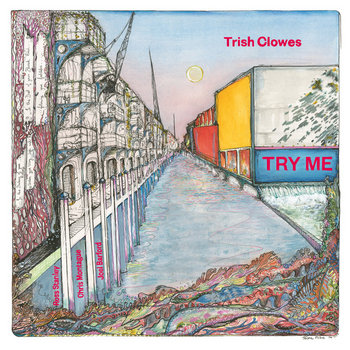
“For The Darklings” takes its title from a line in a poem by guitarist Mike Walker that Clowes set to music for singer Norma Winstone. Some of Walker’s words are incorporated into Triona Milne’s cover art for “Try Me” and Clowes tune title references the “mysterious darklings” mentioned in Walker’s poem.
The music is introduced by the soft patter of Barford’s drums, probably played with bare hands. Organ, and guitar are then introduced before Clowes’ tenor sax emerges to point the way. There’s a relaxed quality about the playing here with Stanley taking the first solo on Hammond, exploring in unhurried fashion and making good use of the many tones and timbres available to him. Clowes follows on tenor, probing gently and intelligently. Montague’s guitar solo is delivered with a quiet intensity and embraces a variety of techniques and effects. The mood of the music is often whimsical, but sometimes hinting at something darker, as befits the title. Barford delivers a subtle and nuanced performance behind the kit.
“Sharp Corner” offers something closer to a traditional bebop feel, led by the fluent musings of the leader’s tenor. Montague follows on guitar and Stanley on Hammond, both supported by the steady tick of Barford’s cymbals. Eventually the drummer is rewarded with his own extended and highly dynamic feature.
Things quieten down a little with “For You”, a ballad introduced by a tenor sax and piano duet that recalls the Clowes / Stanley duo recording. Guitar and brushed drums are subsequently added with Montague temporarily assuming the melodic lead before handing it back to Clowes. The saxophonist then solos more discursively, assisted by the sympathetic support of her colleagues. This is a long running group with a highly developed musical rapport, something that is very much in evidence during quieter moments such as this.
“Whisky” develops out of the combination of Montague’s guitar arpeggios and Clowes’ wispy tenor sax melodies. The swirl of Stanley’s Hammond adds a further layer of melody and texture, with Barford’s drums eventually added to the equation. The piece continues to evolve, gathering momentum via powerful solos from guitar, tenor sax and organ, the music sometimes exhibiting an increasingly discernible rock influence.
Montague’s guitar introduces “Quiet Time”, initially a gentler sounding piece that appears to be living up to its title. Sax, organ and brushed drums make subtle entrances with Clowes’ sax motifs shaping the direction of the music, which develops slowly and organically via expansive, subtly exploratory solos for tenor sax, guitar and organ, some of which gather quite a degree of momentum. The quiet finish with its delicate diminuendo is perhaps more appropriate to the tune’s moniker.
Title track “Try Me” apparently takes its cue from the chords of buskers, developing these in typically interesting and intelligent ways via the solos of Clowes, Montague and Stanley, the latter on Hammond, with Barford unobtrusively driving things along from the back.
“The Inlet” opens atmospherically with the eerie, fog horn like sounds of Clowes’ multiphonics, evoking sounds and images of the infamous London fogs of yesteryear. Other noises variously sound like the creaking of ships’ hulls or the lapping or bubbling of water. Barford’s mallet rumbles and cymbal splashes are also added to the mix, and also the soft drone of Stanley’s Hammond, plus Montague’s extended guitar techniques and effects. This is perhaps the most obviously ‘ambient’ or ‘free jazz’ track that Clowes has recorded.
In a sense “The Inlet” acts as a kind of ethereal overture to “St. Saviour’s Dock”, introduced by a gently piping soprano saxophone motif, quickly joined in duet by Stanley on piano and then by guitar shadings and brushed drums. Lyrical and evocative this piece includes the only true piano solo of the set alongside a wistful soprano sax solo from the leader and a brief passage of soaring, stratospheric guitar from Montague. This lyrical and elegiac track is an appropriate way to round off a consistently excellent and rewarding album.
“Try Me” sees Clowes continuing to hone and develop the My Iris sound and the album compares well with former glories such as “A View with a Room”. The idea to base compositions on the sounds of field recordings has worked well and the resultant pieces are both intelligent and readily accessible, often building from fairly simple melodic motifs to embrace more sophisticated harmonic and rhythmic ideas. My Iris is a particularly well balanced quartet with a remarkable rapport developed over many years of recording and touring, which even the change in the drum chair has failed to disrupt.
blog comments powered by Disqus