

by Ian Mann
January 04, 2026
/ ALBUM
It may have been recorded more than a decade ago but it’s great to have this music out there and available. It still sounds fresh and exciting and just bristles with energy and invention.
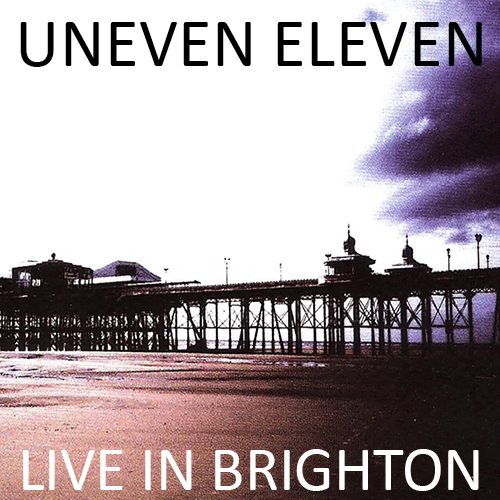
“Uneven Eleven”
“Live in Brighton”
(Discus Music – Discus 203CD)
Makoto Kawabata – guitar, Guy Segers – electric bass, Charles Hayward – drums, vocals
Despite the band name Uneven Eleven is effectively an improvising international ‘power trio’ featuring the Japanese guitarist Makoto Kawabata, Belgian bassist Guy Segers and British drummer / vocalist Charles Hayward.
Of the three I’m most familiar with Hayward, having first heard him back in the 1970s when he was a member of Roxy Music guitarist Phil Manzanera’s Quiet Sun project, appearing on that group’s only album release, 1975’s “Mainstream”. It’s an album that wears its age well and which features Hayward as an instrumentalist, vocalist and the composer of two of the tracks.
He later founded the influential experimental rock band This Heat and its natural successor Camberwell Now before embarking on a solo career that has delivered a dozen albums under his own name.
Hayward has also been a serial collaborator across a range of musical genres, including membership of the trio Massacre with guitarist Fred Frith and bassist / producer Bill Laswell, a band with certain similarities to Uneven Eleven. More recently he has been a member of the collaborative quintet Abstract Concrete.
Kawabata is the leader of the long running and still ongoing Japanese psychedelic rock band Acid Mothers Temple, with whom he has recorded prolifically since the foundation of the group in 1995. He has also worked with numerous other groups in addition to being a prolific solo artist.
Guy Segers is best known as a member of the Belgian instrumental rock band Univers Zero, an act that recorded some fifteen albums between 1977 and 2023. Currently Segers leads the similarly prolific Eclectic Maybe Band and previously led the group Emergent Sea.
He too is a serial collaborator across a range of genres and has also worked as an electronic musician in a long running duo with flautist / keyboard player Roland Binet. Segers has also played alongside Kawabata as a member of Acid Mothers Temple. At one time or another all three members of Uneven Eleven have worked with an edition of Gong.
Although “Live in Brighton” was only released in October 2025 it was actually recorded in May 2013 at the now sadly defunct Brighton venue Sticky Mike’s Frog Bar. That same tour also yielded two other live albums recorded at London’s Cafe Oto. These, together with a whole raft of other recordings featuring Segers with a variety of different line-ups, are available via his Bandcamp page here;
https://guysegers1.bandcamp.com/
“Live in Brighton” features just three tracks, all wholly improvised, that last in excess of twenty one minutes, thirty two minutes and eleven minutes respectively. Yet the music never sounds like ‘free improv’ or ‘free jazz’ in the usual sense. Powered by Hayward’s indefatigable drumming it combines jazz chops with rock energy and a near punk spirit and often sounds as if it may have been written. It was recorded live by Mark Lang and later mixed by Segers.
Here’s what the Discus Music press release has to say about the music;
“A special evening in which the three veterans met on stage, setting the atmosphere on fire with a unique concert, short-circuiting forty years of rock history from blues to noise via the most liquid and rarefied psychedelia.
Charles Hayward has always asserted a very personal idea of improvisation, in some ways equidistant from the abstractness of European free and the muscularity of the jam session. The case of this trio is therefore no exception, in which the musicians nonchalantly range from pounding rock to shifting polyrhythms, from rarefied atmospheres to the searing intensity. The sound is energetic and compact, centred on Hayward’s violent momentum and on the search for an immediate empathy with the audience; free form mixing with an idea of post-atomic fusion.
For the avoidance of doubt, the record sounds almost bootleg-quality, but it doesn’t detract in the slightest from the fury of this trio who, on stage, create rants between punk, hardcore, metal, prog and the like. We’re talking about a power trio in the best punk groove.”
It’s a good summation, and to be honest I didn’t find the sound quality too bad, what’s more important is the way in which the recording captures the visceral energy of the trio in a frequently electrifying live performance.
Album opener “Knead The Beat” sets the tone, a twenty one minute outpouring of energy that emerges out of a swirling atmospheric intro featuring the sounds of electronic effects, presumably generated by the FX pedals of both Kawabata and Segers. Once Hayward starts to lay down an implacable beat that some have compared favourably to the ‘motorik’ rhythms of Krautrock, and particularly Jaki Leibezeit of Can and Klaus Dinger of Neu! we have lift off. The music might be relentless and full on but there’s still plenty of variety on offer thanks to the rich panoply of sounds generated by Kawabata at the guitar who deploys his full range of FX to the max, and then some, and at times also plays the instrument with a bow a la Stian Westerhus. Fabienne Cresens’ photographs on the album sleeve offer visual evidence of this and it also looks as if Segers is playing a six string electric bass. Segers’ low register bass rumble often occupies the middle ground between Kawabata’s overdriven guitar and Hayward’s tumultuous drum onslaught but he raises his head above the parapet periodically, adopting a slightly higher register when his bass playing takes the lead. It’s a genuine musical white knuckle ride given an extra frisson of danger by the cockney-fied sneer of Hayward’s punk like vocalising, although the recording quality makes it difficult to make too much sense of the words, which are presumably spur of the moment, stream of consciousness utterings anyway. Following Hayward’s vocal interjection the performers embrace both extra energy and extra complexity as the music races towards the finish, with Segers’ bass again coming to the fore at times. There’s a final sonic assault from Kawabata’s guitar before the energy finally dissipates and the music seems to collapse in on itself like the audio equivalent to a black hole. Stunning stuff. What an exciting start.
The thirty two minute “Limpid Intone” (Psalmodie Limpide) again begins relatively quietly, but there’s a simmering tension there right from the start as the three instrumentalists intertwine, with Hayward’s drum explosions hinting at further musical fireworks to come. Sure enough the trio are soon locking into another motorik style drum groove, with Segers providing a counter bass motif. Kawabata feeds of these sources of musical stimulation, his chiming guitar figure at the front of this hypnotic three pronged musical assault. Hayward’s “repeat again” vocal refrain emphasises the relentless nature of a music that possesses its listeners and which threatens to trample everything in its path. The spirits of Neu!, and particularly Can, are definitely stalking the room and one can imagine the audience in Brighton willingly embracing a trance like state, the sheer force of the music is irresistible. Eventually there’s a shift in direction but the music remains strange and compelling with heavily distorted guitar now surfing the beats. The music later becomes more chunky and angular with drums and bass variously coming to the fore, with Segers giving notice of his virtuosity before the trio lock together again for a relentless, high energy finish.
The album concludes with the eleven minute “Mineral Knot”, which I suspect may have been an encore on the night. It’s instigated by Hayward at the kit, who punctuates his drum groove with vocal exclamations as Segers locks in with an eerie bass rumble and Kawabata unleashes a wall of wailing feedback, this is a trio that looks to Hendrix as well as to Krautrock. The trio then mesh together with a cerebrally funky collective groove topped by Hayward’s mantra like vocals, a chant centred around the words “beautiful heartbreak”.
It may have been recorded more than a decade ago but it’s great to have this music out there and available. It still sounds fresh and exciting and just bristles with energy and invention, especially as it’s collectively improvised rather than written. Things cohere remarkably well and this trio of experienced improvisers have developed an impressive collective rapport as well as standing out as individuals. Uneven Eleven constitutes a real musical juggernaut.
I enjoyed this album a lot, swept along by both the raw power and the creative energy of the music, even in the comfort of my own home. What it must have been like to be there on the night I can only enviously imagine. Yes, the music can maybe get a little too repetitive at times but the sheer power and energy of the music more than makes up for that, ultimately it’s thrilling, exciting and uncompromising stuff. Kawabata, Segers and Hayward are all virtuosos on their respective instruments, and Hayward’s sheer stamina is something to be admired too as he consistently stokes the improvisatory fires with both drums and voice.
I appreciate that this is music that won’t suit all ears but it gets a definite thumbs up and a recommendation from me for those who are into this kind of thing, including adventurous rock fans who may in any case be familiar with these players from other projects.
blog comments powered by Disqus