

by Ian Mann
August 28, 2026
/ ALBUM
The arrangements are subtle, intelligent and imaginative, respectful of the originals and skilfully adapting the songs to a jazz aesthetic without sacrificing anything in terms of melody and beauty.
James Chadwick Project
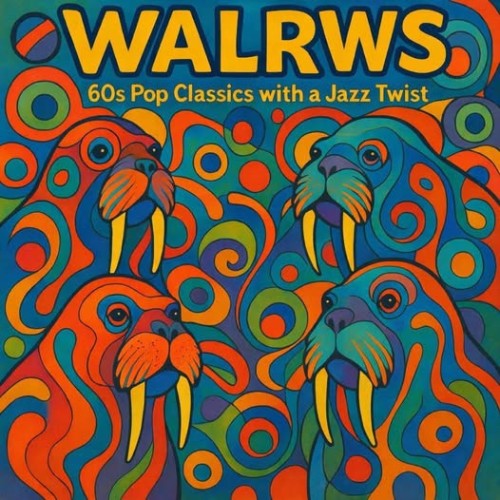
“Walrws”
(33 Jazz – 33JAZZ321)
James Chadwick – guitar, Mark Sambell – piano, Aidan Thorne – double bass, Liz Exell- drums, Josh Heaton – tenor saxophone
In the early years of the 2020s Cardiff based guitarist was the co-leader of J4, a quartet dedicated to playing jazz adaptations of Beatles songs. The group’s arrangements were written by Chadwick and pianist and co-leader Julian Martin and the line-up was completed by bassist Don Sweeney and drummer Ian Williams.
The quartet proved to be a popular attraction on the South Wales jazz circuit and The Jazzmann reviewed J4’s performance at the 2022 Brecon Jazz Festival. The group has also released one eponymous album, that was generally well received.
Chadwick has always been fascinated by the process of arranging unlikely material for jazz performance, including Welsh hymn tunes such as “Calon Lan”. The Walrws project sees him taking the ideas of J4 a stage further with arrangements of a collection of more pop and rock tunes by The Beatles and by other artists from the 1960s, among them Ben E King, Bob Dylan, The Beach Boys and Burt Bacharach. The resultant album takes its title from The Beatles song “I Am The Walrus” and is subtitled “60s Pop Classics with a Jazz Twist”.
For this latest project Chadwick has recruited a core quartet featuring some of the finest musicians currently working in Wales, namely pianist Mark Sambell, bassist Aidan Thorne and drummer Liz Exell. Tenor saxophonist Josh Heaton replaces Sambell on selected tracks. All of these players, and most notably Thorne and Exell, have featured elsewhere on The Jazzmann web pages.
Chadwick himself has also appeared regularly and two of his albums, “Wacahume” (2010) and “Inside Out” (2024) have been reviewed elsewhere on these web pages. Chadwick’s recorded output also includes the earlier “Undercurrent” (2002). These albums place the focus on Chadwick as a composer of original material
The recent “Inside Out” is a trio recording featuring bassist Henrik Jensen and drummer Mark Whitlam. Review here;
https://www.thejazzmann.com/reviews/review/james-chadwick-trio-inside-out
“Undercurrent” was a hugely enjoyable release featuring a core trio of Chadwick, Andy Hamill (bass) and Tom Hooper (drums) plus a strong contribution from guest musician Adrian Fry (trombone), who also acted as co-producer. The album also featured contributions from bassist Jerome Davies and drummer Dave Ohm.
Hamill, who also doubled on harmonica, was still around for “Wacahume”, with Chadwick’s old friend Lee Goodall also performing a key role as both producer and musician. The album was recorded at Goodall’s Oakfield Studios with the proprietor both engineering and producing. The music was documented over the course of two different sessions with the versatile Goodall acting as drummer and percussionist on the six items recorded in the trio format. The other five pieces featured a quartet with Goodall moving to his more familiar alto sax (he’s a more than competent flautist and guitarist too) as the late, great Martin France came in on drums. It represented a considerable coup for Chadwick to have a musician of France’s standing on the recording.
I’ve also seen Chadwick play live many times on the jazz scene in South Wales and the Welsh Marches, mainly playing pieces from the Great American Songbook or some of the better known bebop tunes. Chadwick’s collaborators in this area include Goodall, vocalists Jane Williams and Tara Lowe, bassists Erica Lyons, Ashley John Long, Aeddan Williams, Al Swainger and Paula Gardiner, pianist Dave Jones,, trumpeter Ben Thomas, drummers Rod Oughton and Mark Whitlam, and saxophonists Frank Griffith, Deborah Glenister and Jake McMurchie.
More recent alliances have included his guitar duo with the American jazz guitarist John Stowell. This line up performed a successful show at Brecon Jazz Club in November 2023, which is reviewed, albeit somewhat vicariously, here;
https://www.thejazzmann.com/reviews/review/john-stowell-james-chadwick-guitar-duo-brecon-jazz-club-the-muse-arts-centre-brecon-14-11-2023
“Walrws”, a title that is surely also destined to become a band name, features a total of thirteen arrangements of well known pop and rock tunes from the 1960s. Chadwick himself says of his arrangements for this project;
“This collection of tunes speak for themselves and while I feel the essence of the original has stayed the same a freshness has been added through the arrangements, with harmonic tweaks to a few tunes plus complete re-harmonisations of others”.
He thanks his fellow musicians for their contributions, plus fellow guitarist Dylan Fowler, whose studio near Abergavenny provided the location for this recording. Fowler was also involved in the recording and mixing process.
It’s hard to disagree with Chadwick’s own assessment of the album. All of the tunes are instantly recognisable but all are substantially different from the originals. Obviously this is partly due to the absence of vocals, but in addition to this every piece is subject to a subtle re-invention. Chadwick’s obvious love of his source material shines through and there’s no sense that he’s trying to be overly subversive or ‘clever-clever’, in the manner of, say, Brad Mehldau or The Bad Plus. Instead his re-imaginations sound unforced and organic, staying true to the spirit of the originals but re-inventing them with warmth and imagination. Some of the tunes are spelt differently on the album sleeve, but whether this is to avoid potential copyright issues or is simply the result of lazy proof reading I wouldn’t like to say. What is important is just how fresh and imaginative these new arrangements actually sound.
The album commences with what is effectively the title track, a re-working of the Lennon & McCartney song as “I Am A Walrws”. Introduced by a brief passage of solo piano from Sambell the slowed down arrangement has Chadwick’s slyly re-invented guitar motif at its heart. The use of jazz chords by guitar and piano subtly alters the character of the piece, with Sambell and Chadwick eventually emerging as the featured instrumental soloists. The rhythm team of Thorne and Exell both deliver finely nuanced performances on double bass and drums respectively, with Exell featuring strongly towards the close.
Ben E King’s “Stand By Me” follows. Also famously covered by John Lennon this song is more heavily disguised, the core melody peeking through intermittently during the course of another slowed down arrangement that incorporates thoughtful, subtly discursive, solos from Chadwick on guitar and Sambell at the piano.
The quartet return to The Beatles repertoire for “Elinor Rigby”, which is ushered in by an introductory passage with Thorne’s double bass featuring prominently alongside the patter of Exell’s hand drumming. Chadwick’s guitar eventually picks out the familiar melody before Sambell emerges to deliver an expansive piano solo. The leader subsequently takes over on guitar.
Heaton makes his first appearance on “Daydream”, an adaptation of “Daydream Believer”, composed by the American singer-songwriter John Stewart and famously a hit for The Monkees. Again it’s a slowed down arrangement featuring the sounds of brushed drums and Heaton’s halting tenor sax melody. Heaton subsequently expounds more expansively, followed by Chadwick on guitar and Thorne on double bass, the latter arguably buried a little too deep in the mix. Heaton’s fragile sax reading of the melody returns at the close.
“S.O.S” isn’t a cover of Abba or even The Police, instead it’s Chadwick’s interpretation of Simon and Garfunkel’s “The Sound of Silence”. Introduced by Thorne at the bass its jazzy extemporisations feature some admirably close interplay between the members of the quartet, allied to fluent and thoughtful solos from Chadwick and Sambell. Paul Simon is a composer whose works have become increasingly popular as vehicles for jazz musicians in recent years and on the evidence of this performance it’s easy to see why.
Heaton returns for an intriguing take on “Tambourine Man”, an adaptation of the Bob Dylan song. The saxophonist features even more prominently here with a gently probing solo based around the melody of Dylan’s song. Chadwick provides chordal accompaniment before embarking on his own understated solo, as Thorne and Exell provide economical rhythmic support. Heaton returns to double up with Chadwick towards the close.
The Beatles’ “Blackbird” has also become a favourite for jazz musicians and Chadwick’s elegant and lyrical instrumental arrangement serves the song well. Sambell returns to solo at the piano, alongside Chadwick on guitar, while Exell deploys brushes throughout.
Also from The Beatles catalogue “Penny Lane” is centred around an engaging bass and drum groove, with Exell’s use of sticks and rims a notable feature. The sound of Heaton’s tenor, which almost sounds as if it is laughing, brings a sense of whimsicality to the music, but there’s a hint of darkness too. This is “Penny Lane” as refracted through a distorting mirror with Chadwick and Heaton the featured soloists.
Written by Brian Wilson and Tony Asher “God Only Knows” is one of the most celebrated Beach Boys songs. Chadwick’s arrangement retains something of the wistfulness of the original as it develops from a nagging guitar motif to embrace eloquent solos from Chadwick and Sambell, underpinned by an odd meter groove. Exell emerges towards the close with a neatly constructed drum feature.
“Fool In The Hill” is an adaptation of the Lennon & McCartney song of almost the same name and sees Heaton returning on tenor for a subtly exploratory interpretation. The saxophonist takes the melodic lead, his tentative musings underscored by delicate guitar chording, double bass and Exell’s brushed drum commentary. Chadwick also features as a soloist, his playing exhibiting similarly ruminative qualities. As on the Beach Boys tune there’s an agreeable air of wistfulness that is again entirely in keeping with the original.
The second in a triptych of Beatles songs is “I Feel Fine”, with a loping bass and groove providing the platform for the fluent soloing of Chadwick and Sambell.
Chadwick’s arrangement of “Strawberry Fields” has been in his repertoire for a number of years and I recall seeing him play this song at the 2022 Brecon Jazz Festival as the leader of a trio featuring bassist Ashley John Long and drummer Mark Whitlam. The recorded version adds Sambell’s piano in an arrangement that retains the air of childhood innocence that informed the original, albeit in less grandiose fashion. In Chadwick’s hands the music has more of a conversational feel, as reflected in the unobtrusive soloing of himself and Sambell.
The album concludes with Burt Bacharach’s “Walk On By”, variously a hit for Dionne Warwick and The Stranglers (!), among others. Bacharach’s songs are also popular with jazz artists and Chadwick’s adaptation sees Heaton returning for the last time to share the solos with the leader on an intriguing arrangement that moves through a variety of moods and meters, with Exell’s drums coming to prominence towards the close.
“Walrws” represents an impressive piece of work from Chadwick and his colleagues. Professionally recorded for an established jazz label it represents a step up from the self produced J4 recording, with Heaton’s saxophone a very welcome addition to the mix. The arrangements are subtle, intelligent and imaginative, respectful of the originals but also in the spirit of Chadwick’s original writing, calm, unhurried, unflashy. The playing, from a Wales based ‘supergroup’ is excellent throughout with the musicians buying fully into Chadwick’s vision for his chosen material.
There may be some who sniff at the concept of such a project, but like the J4 project before it this is unmistakably a jazz recording. Once again the arrangements are faithful to the spirit of the original songs but allow plenty of room for variation, improvisation and self expression. They are are thoughtful, imaginative and sophisticated, skilfully adapting the songs to a jazz aesthetic without sacrificing anything in terms of melody and beauty.
“Walrws” is available here;
https://jameschadwck.bandcamp.com/album/walrws
blog comments powered by Disqus