

by Ian Mann
January 26, 2026
/ LIVE
A hugely enjoyable event and the standard of the playing and writing was superb throughout. This is a group that has emerged from the Welsh Marches to achieve national recognition on the UK jazz scene
Will Barnes Quartet, Hay Castle, Hay-on-Wye, 24/01/2026.
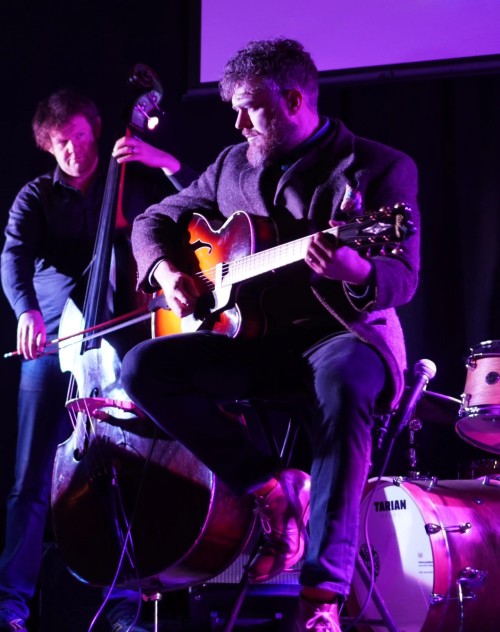
Will Barnes – guitar, Jack Gonsalez – keyboard, Aidan Thorne – double bass, James Batten – drums
Tonight’s sell out event at the recently refurbished Hay Castle was the latest on a hugely successful tour in support of this quartet’s excellent second album “Outside The Light”, released in November 2025 and reviewed here;
“Outside The Light” is the follow up to the acclaimed 2023 release “Source of the Severn”, the album that really put the quartet on the map. Review here;
https://www.thejazzmann.com/reviews/review/will-barnes-quartet-source-of-the-severn
Both of the above recordings feature original music, the majority of it written by Barnes, who draws his compositional inspiration from the landscapes of Mid Wales, the beautiful area that all four band members call home.
Other recordings by the quartet include 2022’s “Time Capsule Vol 1”, a digital release exploring a small selection of jazz standards.
In 2024 a second digital release “Live at Pizza Express, Soho” was a concert recording featuring material from “Source of the Severn” plus a smattering of jazz standards and an arrangement of Stevie Wonder’s “Can’t Help It”.
Barnes is a musician who has appeared on The Jazzmann web pages on multiple occasions. I first saw him perform with the trio Inspector Gadjo, a group that played a mix of Django Reinhardt inspired gypsy jazz and American bebop inspired by the likes of Kenny Burrell and Wes Montgomery. Inspector Gadjo worked regularly with saxophonist Casey Greene and in 2010 released the album “Samba 48”, which is reviewed here;
https://www.thejazzmann.com/reviews/review/inspector-gadjo-trio-featuring-casey-greene-samba-48
Barnes has been a regular visitor to Brecon for both Club and Festival events, appearing alongside such musicians as violinist Sarah Barnwell (once of Inspector Gadjo) and fellow guitarists Deirdre Cartwright and Jean Guyomarc’h. He appears on Barnwell’s eponymous début album, which was released in 2017 and is reviewed here;
https://www.thejazzmann.com/reviews/review/sarah-barnwell
Other musicians with whom Barnes has performed are saxophonist Alan Barnes (no relation, as far as I know), violinist Dan Cassidy and fellow guitarists Frank Vignola, Gary Potter and John Etheridge.
He has also worked extensively with the Shropshire based singer-songwriter Beth Prior, making vital contributions to her album “Little Acts of Kindness” and to the EPs “Nomad” and “Cult”.
Barnes worked for a while with the highly successful gypsy jazz / crossover band Gypsy Fire, has performed with function bands and even turned his hand to reggae and to heavy metal. He remains an avid metal fan and has cited both Black Sabbath and the contemporary Swedish metal group Opeth as sources of inspiration. Opeth likes to take traditional folk melodies and place them in a metallic context, an interesting and innovative niche.
After a while off the scene concentrating on his ‘day job’ as an agronomist Barnes returned to the jazz fold with an exciting new quartet featuring four talented twenty somethings based in his own Mid Wales neighbourhood, pianist Jack Gonsalez, bassist Clovis Phillips and drummer James Batten. This line up appeared on the “Source of the Severn” album and also toured widely, with The Jazzmann covering a series of live shows between 2022 and 2024 in Brecon (twice), Kidderminster and Shrewsbury. The last of these also included live visuals from painter Erin Hughes, who also created the distinctive artwork for the “Source of the Severn” album.
“Source of the Severn” brought Barnes to the attention of a national audience, something encouraged by an appearance on BBC Radio 4’s Loose Ends programme when the quartet played at Hay Festival.
“Outside The Light” featured a new line up with Barnes, Gonsalez and Batten joined by Aidan Thorne, a vastly experienced bass player and a bandleader in his own right. Thorne is also a musician who was appeared on the Jazzmann web pages on a regular basis, both as a prolific sideman and as the leader of his own band Duski. He has also featured as a member of two different guitar / bass duos alongside the contrasting guitar stylists Jason Ball (electric) and Toby Hay. (acoustic). The “Outside The Light” album appears on Toby Hay’s label, Cambrian Records.
The Cambrian Records Bandcamp page describes “Outside The Light” as;
“A bold and expressive new chapter in their artistic journey. Drawing inspiration from local folklore and Celtic mythology, the album explores themes of light, seasons and changing landscapes. This second album deepens the group’s exploration of the interplay between jazz improvisation and the evocative landscapes of Mid Wales and the Welsh Marches.”
In an interview with Bruce Lindsay for UK Jazz News Barnes explained;
“I initially set myself a brief to write 8 pieces that reflect the changing seasons in our landscape here in Mid Wales. As the pieces started coming together, the project evolved, and I drew influence from Celtic folklore. The theme of seasons morphed into themes of light and dark, in particular how the change in light throughout the seasons alters our perception of the landscape and how this has influenced folklore. Each piece is written with a particular place/feeling/story in mind. I will endeavour to recite some of the stories behind the pieces at our live shows.”
On “Outside The Light” the quartet’s sound was less obviously rooted in bebop and was more contemporary in both feel and style. Barnes has cited guitarist Pat Metheny and pianist Brad Mehldau as being particularly significant sources of inspiration for this recording and something of Metheny’s gift for both melody and narrative informed Barnes’ writing for this album.
The historic Hay Castle re-opened to the public in 2022 following a restoration project that commenced fund raising in 2011 and began a four year construction project in 2018. Managed by the Hay Castle Trust it has been restored to a very high standard. It was my first visit to the Castle in its current form for an event and I was very impressed by the standard of the facilities, which include a cafe and shop and very smart and modern toilets! Nevertheless it’s still a very old building and on a cold and wet January night it was still very chilly inside the venue despite the presence of a roaring log fire. If you weren’t sat very close to it you still needed to keep your coat on!
The performance was introduced by Sarah of Hay Castle Trust who thanked the Arts Council of Wales for supporting the event as part of their Nos Allan, or Night Out, scheme. The ACW has been quite supportive of Welsh jazz and the Nos Allan scheme has previously supported jazz events that I have attended in Brecon and Abergavenny.
On the previous occasions that I have seen the Barnes Quartet perform live they have always included one or two jazz standards or other covers in the programme alongside the group’s originals. Tonight, with two full length album releases under their belt, the focus was exclusively on original material with the performance featuring tunes from both “Outside The Light” and “Source of the Severn”.
The performance commenced with “Annwn”, the opening track on the “Outside The Light” album. The tune title is derived from the Celtic word for “the other world”, to which several Welsh locations claim to be the gateway. Ushered in by Batten at the drums and underpinned by a recurring piano motif this was a composition that combined a gift for melody with a strong sense of narrative. Barnes has stated that he wants his composition to tell stories and this is a case in point. The Metheny influence was particularly pronounced here, as evidenced by the unhurried and melodic soloing of the leader on guitar, Gonsalez on his Nord Grand electric keyboard on an acoustic piano setting, and Thorne on double bass.
Also from the most recent album Barnes described his composition “Bloom” as “a sprightly spring number”, a reference to the seasonal theme that informs the music of “Outside The Light”. More obviously rooted in bebop this featured nimble guitar melodies and similarly agile soloing from Gonsalez, Barnes and Thorne. Towards the close the busy Batten was featured at the drums as the quartet teased the audience with a series of false endings.
The quartet returned to “Source of the Severn” for “Machia Wallia”, the title translating from the Latin as “Welsh Marches”. A tune about the questions of identity that arise as the result of living in a border area this composition is jointly credited to the whole quartet and was initially developed out of a series of collective improvisations. The change of personnel with Thorne coming into the band in place of Phillips has resulted in a change of group dynamics. With no disrespect to the very competent Phillips Thorne is a more adventurous player, more obviously rooted in improvisation and experimentation. He’s also highly adept with the bow and this new version of the group features a greater degree of arco playing. Tonight “Machia Wallia” was introduced by an extended passage of unaccompanied bowed bass with Thorne’s deep and haunting sonorities eventually joined in duet by Barnes’ guitar. The pair also work as a duo and just before Christmas 2025 I enjoyed a seasonally themed duo performance from them at the Left Bank in Hereford. The addition of piano and drums saw Batten establishing a groove that formed the basis for solos from Barnes and Gonsalez, the latter’s subtly probing piano excursions incorporating a wilful dissonance that further muddied the waters. Thorne, now playing pizzicato, was featured on double bass, his solo presaging a more powerful riff based section. This tune about “an identity crisis” finally resolved itself by coming full circle with an atmospheric coda featuring just guitar and arco bass.
The band remained with the “Source of the Severn” material by following this with “Katharine’s Bass”, the tune that succeeds “Machia Wallia” on the album. This is a piece that dates from Phillips’ time in the band and refers to Phillips’ double bass which was made in the 1870s and was passed down to him by his grandmother Katharine. A lively bebop number appropriately centred around a bass motif this piece was once something of a feature for Phillips but has now become a vehicle for Thorne. Tonight’s performance also included expansive solos from both Gonsalez and Barnes.
A return to “Outside The Light” and its seasonal theme with “Never Done”, a tune inspired by late summer and by the harvest period in particular. A busy time of the year reflected by an appropriately bustling tune that again exhibited a pronounced bebop influence. Propelled by Batten’s rapidly brushed drum grooves Barnes’ agile guitar soloing was sometimes reminiscent of one of his guitar heroes, the late, great Wes Mongomery, about whom more later. Gonsalez followed at the piano and Batten, still wielding brushes, was featured at the drums. Thorne soloed next on double bass before Barnes returned for a second bite at the cherry, or should it be apple at this time of year?
An extended solo guitar intro ushered in “An Echo of Spring”, another seasonally inspired composition that actually appeared on the “Source of the Severn” album. A lyrical and elegant ballad this saw Batten’s delicate brushwork underpinning richly melodic solos from Gonsalez on piano and Thorne on double bass.
A lengthy first half concluded with “Devil’s Bridge”, a piece from the “Outside The Light” album. Drawing inspiration from both landscape and legend this episodic composition was notable for Barnes introducing something of a flamenco / North African / Middle Eastern aspect to his playing, his guitar sounding almost oud like at times. This was very much a ‘tune of two halves’ the second and final section featuring hypnotic piano and guitar motifs and the distinctive sound of Thorne’s bow on the bass strings. One was almost reminded of Dan Berglund of E.S.T.
Set two began with a segue of tunes from the “Outside The Light” album, commencing with Gonsalez’s composition “Lleuad Fedi”. Ushered in by the composer’s arpeggiated piano the piece featured Barnes’ melodic, subtly blues tinged guitar as he shared the solos with Gonsalez himself.
As on the album Gonsalez’s beautiful and atmospheric piece was immediately followed by “Otherworld”, kickstarted by Thorne’s double bass groove and featuring a tricky unison melodic theme. It’s a fast moving piece that combines the quartet’s bebop leanings with a more contemporary episodic approach that is suggestive of that acknowledged Metheny influence. Barnes and Gonsalez both delivered sparkling solos and there were also features for both Thorne and Batten.
Introducing “The Longest Day”, another tune from “Outside The Light”, Barnes promised us “something more chilled out”, which seemed uncomfortably appropriate given the arctic temperatures inside the castle. Gonsalez’s solo piano intro evolved into a piano / guitar duet, with bass and brushed drums subsequently added to this richly melodic performance that featured lyrical solos from Barnes and Gonsalez followed by a more loosely structured passage featuring Thorne’s double bass. Following this bass led episode a more melodic guitar fronted theme emerged, this introducing something of an anthemic quality.
It was back to “Source of the Severn” for “Lie Mae Trefaldwyn”, the title translating as “Where’s Montgomery”, a clever reference to one of Barnes’ jazz heroes, as well as to the composer’s geographical location. Welsh audiences laugh at the joke immediately, the English have to have it explained to them – but it’s still funny. Barnes also cites Herb Ellis, Joe Pass, Kenny Burrell, Barney Kessel, Grant Green, Jim Hall and Pat Metheny as being among his favourite guitarists. He has also acknowledged the inspiration of pianists Oscar Peterson, Brad Mehldau and Bill Evans. “Lie Mae Trefaldwyn” is another piece that combines Barnes’ love of bebop with a more modern episodic approach with the piece progressing via solos from Gonsalez, Barnes and Thorne, with Batten’s increasingly dynamic drumming then fuelling a second excursion from Barnes.
From “Outside The Light” Barnes dedicated his composition “The Light of the Beacons” to “a person who is no longer with us”, but didn’t elaborate further. The tune itself is a beautiful tribute to its mysterious dedicatee, introduced here by the sounds of guitar, bowed bass and the subtlest of almost subliminal drum colourations. As Thorne switched to the pizzicato technique piano was also added, with Batten sitting out for a while before picking up the brushes once more in support of Barnes gentle and lyrical guitar soloing. Thorne took up the bow again towards the close, with Batten switching to mallets.
This second set concluded with “The Mad March Hare”, actually the opening track on the “Source of the Severn” album. This is a piece that was written by Barnes in 2020 during the first Covid lockdown. As befits its title the music was suitably lively and playful with Barnes’ agile, bebop inspired guitar soloing supported by Gonsalez’s lightly dancing and prancing piano motifs and the crisp, propulsive support of bass drums. Effervescent solos from Barnes and Gonsalez were followed by an exuberant drum feature from Batten.
The audience warmed their hands with a rapturous round of applause and Sarah had little difficulty in persuading the band to return to the stage for a deserved encore. This proved to be the title track of “Source of the Severn”, the final track on that album and an episodic piece with a strong narrative arc that appears to trace the journey of the river and in hindsight also seems to act as a stepping stone towards the even more personalised music of “Outside The Light”. The tune was introduced by Gonsalez at the piano, his rippling arpeggios establishing the watery theme as the music progressed via the fluent soloing of both Barnes and Gonsalez, the flow of the music punctuated by quieter passages, much like that of the river itself.
Despite the chilly temperatures this was a hugely enjoyable event and the standard of the playing and writing was absolutely superb throughout. I first witnessed a live performance from what was then known as “Will Barnes’ New Young Quartet” at Brecon Jazz Festival in August 2022 when they played a mainly standards based set punctuated by a sprinkling of Barnes’ originals, some of which eventually found their way onto “Source of the Severn”. That was a hugely enjoyable event but for me it’s been a pleasure to witness just how much the band have kicked on since then, culminating in two full length album releases and tonight’s performance featuring all original material, with all the tunes from “Outside The Light featuring alongside a substantial proportion from “Source of the Severn”.
On the evidence of recent sold out shows in Ross-on-Wye and tonight in Hay the Barnes Quartet has clearly built a substantial following, achieving this both through the quality of its recordings and a Metheny like work ethic that has seen them touring regularly and consistently delivering high quality live performances with Barnes a succinct and informative announcer of tunes. In the internet age maybe it’s an old fashioned way of cultivating an audience – but this is jazz and it’s a method that’s clearly working for the likeable Barnes and his colleagues.
This is a group that has emerged from the Welsh Marches to achieve national recognition on the UK jazz scene with “Outside The Light” being favourably reviewed by Peter Jones in the December 2025 / January 2026 edition of Jazzwise magazine. The quartet are also scheduled to perform at London’s famous Pizza Express Jazz Club in Dean Street, Soho on Sunday February 8th 2026. It’s going to be busy day for them as they’re also playing The Stables in Wavendon, Milton Keynes at lunchtime – that Metheny like work ethic again! For details of all live dates by the Will Barnes Quartet please visit;
https://www.willbarnesmusic.co.uk/live-dates
My thanks to all four band members for speaking with me after tonight’s triumphant performance. As I say it’s been a pleasure to witness the rise of this quartet, and to have hopefully played a small part in its success thanks to the regular coverage of their music on this site.
blog comments powered by Disqus