

by Colin May
March 30, 2026
/ LIVE
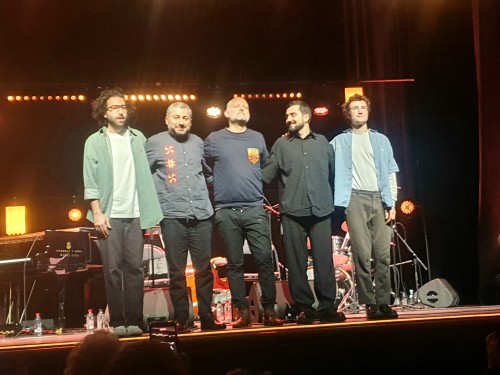
"I hope he gets this excellent quintet into the recording studio soon, as their music deserves to be heard widely". Colin May enjoys the music of French-Armenian pianist Yessaï Karapetian.
Yessaï Karapetian Quintet
Princess Grace Theatre, Monaco
Sunday 22nd March 2026
Yessaï Karapetian piano
Norayr Gapoyan, duduk
Avag Margaryan, blul
David Paycha, drums
Damien Varaillon, double bass
French-Armenian pianist composer Yessaï Karapetian has taken a deep dive into the music and culture of the land of his birth with the incorporation into his quintet of a duduk, a very old double reed instrument noted for it’s warm and mellow tone, and a blul, an oblique end -blown flute crafted from wood from an apricot tree and with a velvety slightly muted sound. The two instruments are believed to have been used for centuries by Armenian shepherds to make music to ameliorate their lonely vigil.
I knew nothing about Karapetian prior to this concert which was just one of many interesting concerts in the Printemps Des Arts de Monaco, but the only jazz concert according to festival director Bruno Mantovani’s introduction. The information in the festival programme said the presence of the duduk and the blul was a new development in Karapetian’s music. He certainly seems to have made a change since his 2022 album ‘Yessaï’, his only recording so far as leader. Back then any Armenian influence was submerged by other genres, at least that was the conclusion of Jazzwise’s reviewer Brian Priestly for whom “ The feel of the whole 39 minutes suggests a scenario of ‘progressive rock meets post-fusion jazz, and wins”. https://www.jazzwise.com/reviews/yessai .
Tonight was nothing like this. Karapetian had not only introduced the duduk and blul into the line-up but the drummer and bass player were different from he album. Perhaps there was a hint that this new approach was still evolving in the fact that the bass player according to the festival programme was due to play an electric bass when actually he played an acoustic double bass throughout.
It turned out that not only were the duduk player and blul player virtuosos but that the young and studious looking David Paycha on drums and Damien Varaillon on double bass were also superb. A special word of praise must go to Paycha for his endlessly creative, subtle and sensitive ensemble work that set such a high standard that his two solos when he cut loose were slightly disappointing in comparison. Varaillon was terrific too, his playing rich in invention, I thoroughly enjoyed his solos, and like Paycha he was consistently serving Karapetian’s vision. The two made a very high quality engine room.
The concert fell into two halves divided by the one instance of Karapetian talking to the audience not to introduce the music or name numbers but to thank Printemps Des Arts for the opportunity and its director for support when he was a student. What I am calling the first half was about 50 minutes of music without a break with the numbers seguing . Karapetian’s piano at times probed and he had one big solo towards the end which had him out of his piano seat but largely he limited himself to a supporting role at one point playing a repetitive figure in the left hand which echoed Philip Glasses études. In the second part not only was his soloing much more prominent with impressive technique and dynamic variation but his ensemble playing too was more forceful. He ended the concert with the proverbial bang by playing a thunderous chord progression.
The quintet had got the evening off to a flying start with a dazzling opening section/ number. After the contrast of a chilled walking double bass and urgent drumming using all elements of the drum kit, Karapetian then joined with some probing piano. The blul then entered, playing wispy notes quickly followed by the duduk. The Armenian instruments then launched into what came across as improvised feverish jazz, though there probably were Arminian folk dance tunes sweeping aside doubts that jazz could be played on these instruments.
Twists and turns cascaded after one another including into minor keys and there were moments that were not far from free jazz with the Armenian instruments being played over a driving rhythm from drums, bass and piano. The quartet drove on to a frantic finish that if this concert had been in the Lino Ventura venue in Nice the typical audience there would have been out of their seats and dancing.
Festival director Bruno Mantovani had said in his introduction that particularly the duduk but also the blul had featured many times in film music and its traditional evocative qualities did emerge many times during the concert . My brief notes refer to sounds like wordless vocals, to trees swaying in the wind, to a melancholy tone, to a human voice calling and to a human voice singing. In these more cinematic passages jazz played by the piano trio was still going on underneath. So sometimes the duduk and blul were playing jazz, and sometimes they were played in what I assume was a more classic Armenian style. but one that still worked successfully with the jazz. Of the two instruments my impression was that the blul has the greater range and flexibility when it comes to jazz, and there were a couple of solo’ that Finn Peters or Eric Dolphy would have been proud to have played on flute.
Karapetian who is now in his thirties, was raised in Marseilles and studied in Paris before a one year scholarship to what we might think off as the prime jazz finishing school at Berklee. At six alongside classical piano lessons he was learning to play Armenian flutes (source: festival programme) so probably understands the blul and duduk from the inside, so to speak. This knowledge must have contributed to the highly successful arrangements that brought together the Armenian instruments with those of the classic piano so well.
I am not sure whether the more famous fellow Arminian pianist composer Tigran Hamaysen, with whom Yessaï Karapetian has toured, ever has had a blul and duduk in his line-up. If not Karapetian is breaking new ground. But even if he isn’t I hope he gets this excellent quintet into the recording studio soon, if he hasn’t already, as their music deserves to be heard widely.
blog comments powered by Disqus