
by Ian Mann
November 26, 2026
A day of widely varied but exceptional music with performances from Constantinople, The London Jazz Orchestra, Anouar Brahem, Julie Campiche and the Elina Duni / Rob Luft Duo.
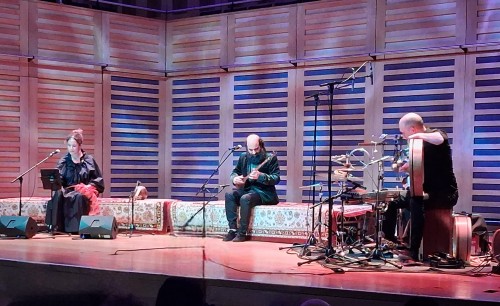
Photograph of Constantinople by Pam Mann
EFG LONDON JAZZ FESTIVAL 2026
DAY 3, 15th NOVEMBER 2026
CONSTANTINOPLE – ‘ESTUARY’
KINGS PLACE, HALL ONE
Kiya Tabassian – setar, vocals, Patrick Graham – percussion, Ghalia Benali – vocals
with Adib Rostami – kamancheh
Kings Place has established a strong reputation for hosting high quality ‘world jazz’ events as part of the annual EFG London Jazz Festival.
This lunchtime show was a case in point as it presented the trio Constantinople performing the music of ‘Estuary’ in a performance billed as “a musical journey where cultures, traditions, and human stories converge.”
Originally the line-up was scheduled to include the Iranian setar player and vocalist Kiya Tabassian, the Canadian percussionist Patrick Graham and the Senegalese kora player and vocalist Ablaye Cissoko. The music was intended to create a dialogue between the Persian and Mandinka musical traditions and to celebrate a shared humanity and the merging of musical traditions.
Tabassian and Cissoko have worked together under the Constantinople banner for more than a decade but for this London concert Cissoko was denied a work visa by the British authorities. Go figure.
Undeterred Tabassian and Graham invited the Belgian / Tunisian vocalist Ghalia Benali into the fold as the member of the core trio with Adib Rostami guesting on some pieces playing the Persian bowed string instrument the kamancheh.
Group leader Tabassian plays the setar, a four stringed, long necked Persian lute. His virtuosity on the instrument was apparent right from the beginning of today’s concert as he opened the proceedings with a passage of unaccompanied setar.
Graham eventually joined him playing a percussive set up that included a variety of frame drums, cymbals, bells and shakers in addition to elements of the conventional western drum kit.
Benali made her entrance walking through the audience, singing without a mic but still generating an impressive vocal power. It was an impressive and effective introduction.
Benali joined her colleagues on the stage to perform a kind of desert blues, her powerful vocals augmented by simple, but dramatic and highly effective hand gestures, these sometimes augmented by the flourishing of a bright orange ostrich feather. Benali is also an actress and there was very much an element of theatre and the sense of her telling a story as she sang. Even if one couldn’t understand the words the listener still felt a sense of involvement.
Graham mainly played his array of percussive devices with bare hands or mallets. Like the late, great Collin Walcott he’s something of an ethnomusicologist with a broad knowledge of a wide range of musical traditions. He has performed with numerous collaborators from around the world and is a truly global musician.
The lengthy opening sequence lasted for half an hour and embraced setar and vocal duets, frame drum and setar dialogues and the addition of Tabassian singing voice to Benali’s, the pair combining very effectively at certain points in the performance.
We later learnt that the two songs that formed the opening segue were based on the writings of the great Persian poet Rumi (1207 – 73) who remains an inspirational figure for artists across many disciplines, including many jazz musicians, all these centuries later.
During the course of today’s performance Benali sang in both Pharsee and Arabic, usually solo but often in conjunction with Tabassian. The second fifteen minute sequence featured their joint vocalising alongside instrumental soloing on the setar, with Graham providing sympathetic percussive accompaniment.
The third sequence, titled, “Footsteps” featured the words of more contemporary poets, still following in the traditions of the great Rumi. Delivering words rooted in the poetic and story telling traditions Benali’s vocal performance was both passionate and dramatic, her powerful singing augmented by the empathic accompaniment of Tabassian and Graham, who also enjoyed moments of instrumental debate in addition to virtuoso individual features.
Rostami was added to the line-up for the next fifteen minute segue, which was introduced by a passage of unaccompanied setar. Rostami subsequently joined Tabassian in duet, with Graham subsequently added on percussion. His percussive undertow provided the necessary impetus for Rostami’s kamancheh solo, with Tabassian subsequently adding his singing voice to the proceedings.
Graham’s percussion solo then provided the link into the next section, which also featured Rostami and saw the return of Benali’s vocals.
The final sequence featured the words of Arabic poets followed by those of Rumi and was performed by the core trio, with Tabassian introducing the proceedings on setar. Benali subsequently added her voice in duet, with Graham joining soon after. Again the percussionist provided the link into the final section with Benali’s singing of Rumi’s words augmented by the instrumental interplay of Tabassian and Graham.
The absence of Cissoko didn’t seem to phase the audience, and in any case Benali had done a terrific job in his place, although she could hardly be considered a straight replacement. The new, possibly one-off edition of Constantinople were given a rousing reception by the Kings Place crowd and both Benali and Tabassian were presented with flowers on stage.
The inevitable encore saw Rostami rejoin the band as the voices of Benali and Tabassian combined, with space also granted to the instrumentalists.
Despite the initial set back the show had been a triumph for Constantinople and it was a performance that I found to be both fascinating and enjoyable, a voyage into what were largely uncharted musical waters for me featuring unusual instruments and unfamiliar cultural references. The standard of the singing and playing was excellent throughout – in any language, and this was a performance that carried on a fine Kings Place tradition.
LONDON JAZZ ORCHESTRA, THE VORTEX
The length of the Kings Place show, and particularly the unexpected and seemingly spontaneous encore, meant that I was a little late arriving at The Vortex for this afternoon performance by the London Jazz Orchestra.
Directed by Scott Stroman the LJO features a whole host of London’s leading jazz musicians and holds a regular monthly Sunday afternoon residency at The Vortex, a residency that dates back some twenty eight years! The personnel has, of course, changed over time but I found that I knew most of the musicians in today’s line-up.
Here are the names of the people that I recognised plus other names that I discovered after doing a bit of online research;
Scott Stroman – director
Tori Freestone – tenor sax, alto flute
Tom Jarvis – tenor sax
Martin Hathaway – alto sax, clarinet
Howard McGill – alto & soprano sax
Luke Lane - trumpet
Henry Lowther – trumpet
Andre Canniere – trumpet
Martin Gladdish – trombone
James Wade- Sired – trombone
Olli Martin – trombone
Yusuf Narcin – bass trombone
Alcyona Mick – piano
Nick Costley – White – guitar
Chris Hyde-Harrison – double bass
Paul Clarvis – drums
Brigitte Beraha – vocals
There were one or two other musicians in the band whose names I didn’t catch, but nevertheless the above list is fairly comprehensive and gives a good idea of the quality of the musicians within the band’s ranks.
The LJO does not play jazz as repertory but instead focusses on the original writing of its members, although it has to be said that this is very much within the contemporary big band tradition pioneered by former members such as Kenny Wheeler and John Taylor.
I arrived just in time to catch the conclusion of a piece featuring solos from Gladdish on trombone and Hathaway on clarinet.
The first item that I heard in full was “Elephants On Wheels”, written and sung by vocalist Brigitte Beraha. The piece was inspired by Kenny Wheeler’s music on the album “Music For Large And Small Ensembles” allied to the visual imagery of Salvador Dali! Apparently Beraha had a Dali print on the wall of her room where she immersed herself in the sounds of Wheeler’s album. The song was recorded as long ago as 2012 on the album “Red Skies”, a duo recording featuring Beraha and pianist John Turville. Today’s big band version featured Beraha’s Norma Winstone inspired vocalising alongside the instrumental soloing of saxophonist Tom Jarvis and the veteran trumpeter Henry Lowther.
Director Stroman’s own “Love Is A Game” commenced with a gentle reed chorale that featured the sound of Freestone on alto flute. Beraha gave voice to the song’s wistful lyrics while McGill delivered a concise alto solo. The sounds of muted trumpets were also notable in the arrangement.
Guitarist Nick Costley -White composed the all instrumental “Conscious” and functioned as one of the featured soloists alongside saxophonist McGill, this time playing soprano. The piece was also notable for a series of tenor sax exchanges between Freestone and Jarvis.
The Orchestra’s regular baritone sax player Mick Foster was the composer of “When The Rain Falls”. I failed to catch the name of his ‘dep’, who was one of the featured instrumental soloists alongside trombonist Olli Martin. This was a song that also featured the exquisite singing of Beraha.
It was becoming a recognisable pattern that the composer of any individual piece should also be one of its featured soloist. This was the case on “Suzy’s Song”, written by trombonist James Wade-Sired, who shared the solos with pianist Alcyona Mick.
A very enjoyable performance concluded with “The Ground Beneath”, a composition by trumpeter Andre Canniere, a musician who has appeared regularly on The Jazzmann web pages as both leader and sideman over the years. Naturally the composer was one of the featured soloists, alongside Freestone on tenor sax, Costley-White on guitar and Mick at the piano.
As it had been the night before for the Ari Hoenig trio gig The Vortex was absolutely packed for this performance with the Club’s Sunday afternoon regulars joined by eager Festival goers, some, like me making an annual visit. It all made for a very convivial atmosphere with Stroman and the LJO feeding off the goodwill of the crowd.
The LJO will return to The Vortex on the afternoon of Sunday December 6th 2026, when they will be supported by the Essex Youth Jazz Orchestra, directed by the LJO’s own Martin Hathaway.
I thoroughly enjoyed my two visits to The Vortex for this year’s EFG LJF and I’m grateful to the venue’s Ollie Weindling, who is also the proprietor of the Babel record label for providing me with review copies of the label’s latest album releases from vocalist Heidi Vogel and the saxophone / piano duo of Iain Ballamy and Gareth Williams. More on these on our review pages later. It’s always good to catch up with Ollie, whose love and knowledge of the London and wider UK jazz scene is wide and deep and whose work as facilitator is warmly appreciated by musicians and fans alike.
ANOUAR BRAHEM, THE BARBICAN
Anouar Brahem – oud, vocals, Django Bates – piano, Anja Lechner – cello, Mats Eilertsen – double bass
The Barbican was totally sold out for this performance by the Tunisian oud master Anouar Brahem who was leading an international quartet featuring the Norwegian bassist Mats Eilertsen, the German cellist Anja Lechner and the UK’s own Django Bates at the piano.
Brahem has enjoyed a long association with the Munich based ECM Records dating back to 1991 and he has released a total of eleven albums for the label. The latest of these is “After The Last Sky”, released in 2025 and featuring Bates and Lechner with Dave Holland in the bass chair.
The album title is derived from the writings of the Palestinian poet Mahmoud Darwish, whose work also inspired Brahem’s 2009 release “The Astounding Eyes of Rita”. However it was the repertoire of the latest album that was at the core of tonight’s performance, with Eilertsen taking over the bass duties from the unavailable Holland.
I’ve yet to hear the “After The Last Sky” recording but my desire to see Brahem perform live was fuelled by my enjoyment of his excellent 2017 release “Blue Maqams”, a recording that featured Bates, Holland and the late, great Jack DeJohnette at the drums. My review of this wonderful recording can be found here;
Tonight’s performance was focussed on the “After The Last Sky” album and was introduced by the esteemed jazz journalist and broadcaster Kevin Le Gendre who explained that with this recording Brahem was seeking to achieve a synthesis between traditional Arabic music, jazz, and classical chamber music. With this unique, drummer-less line-up this was very much what Brahem and his quartet delivered, a kind of North African flavoured brand of chamber jazz.
Once Le Gendre had said his piece verbal announcements were very rare and the only tune to be formally introduced was the album title track. Therefore this review will not be a tune by tune review but will instead attempt to provide an overview of the performance as a whole. I suspect that the quartet played the majority of the album, but not in the recorded sequence.
Throughout the performance the quartet performed with a chamber music sensibility and the delicate interplay between the instruments was consistently absorbing and unashamedly beautiful.
Lechner is primarily a classical player and like Brahem has also enjoyed a long association with ECM, mainly recording for its New Series classical imprint, although she has also worked for the label with the Argentinian bandoneonist Dino Saluzzi. Lechner’s rich, warm cello tones, played with great technical proficiency, brought a classical sensibility to the Brahem group’s music.
Brahem is arguably the world’s leading oud player, a claim substantiated by the fact that he is capable of filling a concert hall as large as the Barbican. However his performance tonight was less about individual virtuosity and more about serving the music that he had composed. He was largely content to be a member of the ensemble rather than a featured soloist, and this spirit of mutual
co-operation was a characteristic of the performance as a whole from this supremely balanced quartet, four individually brilliant talents pooling their musical resources in pursuit of the common cause of grace and beauty.
Bates is a famously idiosyncratic performer and composer who first made his name with the celebrated British big band Loose Tubes before embarking on an eclectic, genre hopping solo career. He has recorded three albums as a leader in the piano trio format for ECM and also appeared on Brahem’s “Blue Maqams” and “After The Last Sky”. His playing with Brahem’s groups has been a revelation, blending discipline with imagination to produce something very beautiful. It’s very different to the wilfully eclectic spirit of many of his own recordings.
Eilertsen is a band leader in his own right and a busy presence on the Norwegian jazz scene. His ECM connection is as a former member of pianist Tord Gustavsen’s trio and his skill and versatility makes him the perfect replacement for Holland.
A total of ten individual pieces were performed as the main set, all performed within the same chamber jazz aesthetic, or even the ECM aesthetic if you will. Key to the success of the music was the sensitivity of the players and the delicate interplay between the instruments, one could sense that the group members were listening to each other at all times.
Within the overall musical discussion there were numerous ‘sub-conversations’, including duets between oud and bass, oud and piano, cello and piano and various other dialogues between different combinations of the ensemble.
One piece was notable for the use of the bow by both Lechner and Eilertsen, working in tandem alongside Brahem and Bates.
This wasn’t a straight-ahead jazz performance and as a consequence there were no jazz solos in the conventional sense. There were however several passages of unaccompanied playing. Brahem would often introduce tunes alone on the oud, sometimes singing along to his own melodies in a soft baritone, a reminder of the oud’s role as an accompanying instrument in traditional Arabic music.
One passage of solo piano from Bates, later augmented by cello and bass, was warmly applauded by the Barbican audience, but in the main there was little applause for individual moments of virtuosity. In the main the audience approached the concert with a classical sensibility, although they did clap at the end of each piece. However I did notice a little reticence even with regard to this. But at at the end of the performance the applause was truly tumultuous with many members of the audience getting to their feet. There was a palpable sense of pent up tension finally being released.
A word on a couple of the individual pieces. The words of Darwish’s poem were written in 1986 but Brahem feels that they have taken on a contemporary resonance in the light of recent events in Gaza. His oud and voice introduction to “After The Last Sky” was imbued by a profound sadness that was further emphasised by the melancholy ring of Lechner’s cello and the luminous beauty of Bates’ carefully measured piano solo.
The deserved encore sounded naggingly familiar and was later identified by my fellow reviewer Julian Maynard-Smith, writing on this occasion for the Classical Source website, as being “Vague / E la nave va” from Brahem’s 2006 album “Le Voyage de Sahar”. Centred around Bates’ piano ostinato this final offering included individual features for both cello and oud.
After the show I had intended to purchase a copy of the “After The Last Sky” album but the queues for the merch desk were so long that I quickly abandoned that idea and made my way rapidly down Silk Street to The Jazz Social for my next scheduled event. The fact that the lines were so long was a testament to the success of the performance, although I have to admit that I found it all a little too soporific at times, especially in a huge space like the Barbican where despite having a very good seat I still felt a little detached from the musical action. On reflection I would probably have preferred to have seen a version of the “Blue Maqams” instrumental configuration, but nevertheless there was much to enjoy here.
JULIE CAMPICHE
ELINA DUNI & ROB LUFT DUO
THE JAZZ SOCIAL
The Jazz Social pop up venue is just down the road from the Barbican so I thought I’d call in on the way home after the Brahem concert to catch something of the double bill featuring the Swiss harpist and vocalist Julie Campiche and the Anglo-Albaninan duo of guitarist Rob Luft and vocalist Elins Duni.
JULIE CAMPICHE
The Jazz Social event had been billed as starting at 9.00 pm and following the 7.30 pm show at the Barbican I hoped to catch the majority of it.
Unfortunately the music at the Jazz Social actually kicked off at 8.30 pm and I was only able to catch the very last moments of Julie Campiche’s solo set as I entered the venue to the sounds of delicately plucked harp and ethereal wordless vocals. I was so disappointed not to have been able to hear much more of this.
Campiche had been playing music from her acclaimed solo recording “Unspoken”, an album that features the sounds of harp, vocals and electronics. I understand that electronics had been deployed earlier in tonight’s set and I suspect that Campiche may have performed the album in full. I’m pretty certain that the brief snippet of music that I actually heard came from the concluding track “Zaina”.
“Unspoken” represents Campiche’s most overtly political work to date as this mother of two examines the world from a strongly feminist perspective. To read more about the album please visit my review here;
https://www.thejazzmann.com/reviews/review/julie-campiche-unspoken
Campiche also leads a quartet featuring the talents of saxophonist Leo Fumagalli, bassist Manu Hagmann and drummer Clemens Kuratle. I have reviewed two of the quartet’s albums, “Onkalo” (2020) and “You Matter” (2022) plus a live performance at the 2022 Wall2Wall Jazz Festival in Abergavenny where I was lucky enough to chat with Julie and the band. She is such a warm and welcoming human being and tonight greeted me as an old friend, despite me missing most of her set - and feeling absolutely gutted about it.
Campiche is a vital presence on the European jazz scene. Do please check her out.
ELINA DUNI / ROB LUFT DUO
Elina Duni – vocals, frame drum
Rob Luft – guitar, electronics
It was turning into something of an ECM themed evening as Anouar Brahem was followed by the duo of Swiss-Albanian singer Elina Duni and the British guitarist Rob Luft.
The duo have recorded two albums for ECM, 2020’s “Lost Ships”, which is reviewed elsewhere on these web pages, and “Reaching for the Moon”, which was released earlier in 2026.
Tonight the focus was on material from the latest album in an intimate performance in a small space. Duni was born in Albania but was brought up in Switzerland from the age of ten. However she has not forgotten her roots and the presence of a lively Albanian contingent in the audience, personal friends of Duni’s, helped to enhance the atmosphere, and particularly when the duo performed folk songs from Albania and Kosovo, giving them the opportunity to sing along.
Duni had already recorded three albums for ECM before teaming up with Luft and is clearly well established with the label. As a solo artist Luft has been associated with the British Edition label, but I suspect that we will hear more from him on ECM in the future.
Duni and Luft like to explore a broad range of musical material and tonight’s repertoire also included folk songs from Switzerland and Romania plus jazz standards and singer-songwriter material.
Duni has an impressively pure, and when necessary powerful, singing voice and is also a talented multi-instrumentalist who played all the instruments (guitar, piano, percussion) on her 2017 release “Partir”, a genuine solo album. Tonight she played a Persian frame drum on some numbers, adding rhythm to the effects enhanced sounds of Luft’s guitar. Luft is a musician with an instinctive mastery of technology which he deploys in the service of the music with great skill and imagination, taking an almost orchestral approach to his guitar playing. He has developed a sound that is increasingly unique, but one that feels at home in a broad range of musical formats and with a similarly wide range of collaborators. He’s one of the most in demand musicians on the UK jazz scene.
Among the songs performed were “Reaching for the Moon”, Irving Berlin’s album title track, and the Mal Waldron song “Where Is The Love?”, originally written for Billie Holiday. There was also a stunning vocal version of Ornette Coleman’s “Lonely Woman”, including the rarely heard lyrics. Equally beautiful was the duo’s interpretation of the Nick Drake song “River Man”, originally recorded on Drake’s 1969 debut album “Five Leaves Left”.
This was another highly enjoyable performance and a visit to the informal performance space that is The Jazz Social represented an excellent way to end a day of widely varied but exceptional music.
I’m a huge fan of Rob Luft, a musician whose recordings and live performances have been covered on these web pages on a regular basis. It was also a pleasure to chat with him after the show, he’s a humble guy with a huge talent who thoroughly deserves the success and acclaim that has come his way.
blog comments powered by Disqus