

by Ian Mann
June 02, 2026
/ LIVE
An excellent evening of music played to a packed house. The standard of the playing from five of Wales’ finest was excellent throughout, and of course the material itself was genuinely ‘classic’.
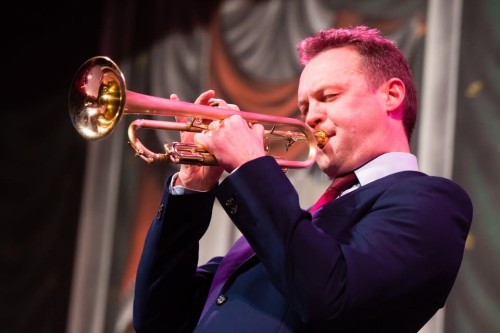
Tomos Williams Quintet, ‘ 7 Steps, The Music of Miles Davis’, Black Mountain Jazz, Melville Centre for the Arts, Abergavenny, 31/05/2026
Tomos Williams – trumpet, Joe Northwood – tenor sax, Dave Jones – piano, Aidan Thorne – double bass, Mark O’Connor – drums
There was a sell out crowd at the Melville Centre for this event, there literally wasn’t a spare seat available in the house.
In the week of the centenary of Miles Davis’ birth (26th May 1926) when the music of the jazz legend has been all over the airwaves perhaps this wasn’t so surprising. The presence of some of the finest musicians on the Welsh jazz scene, many of them established BMJ favourites, no doubt also helped. Amazingly it was actually leader Tomos Williams’ first time at BMJ, but saxophonist Joe Northwood, pianist Dave Jones, bassist Aidan Thorne and drummer Mark O’Connor have all been regular performers at BMJ over the years.
But there’s far more to Tomos Williams than just a Miles Davis tribute act. 7 Steps is just one of many projects, including the acclaimed Cwmwl Tystion series of tours and live recordings.
The title “Cwmwl Tystion” (literally ‘a cloud of witnesses’) is originally Biblical in source and was derived from a poem by the Welsh poet, pacifist and nationalist Waldo Williams (1904-71) called “Beth yw Dyn?” (or “What is Man?”). Cwmwl Tystion has now effectively become a band name.
The Cwmwl Tystion project was initially intended as a response to Brexit and was influenced by the politically inspired music of leading American jazz musicians such as trumpeters Wadada Leo Smith, Ambrose Akinmusire and Don Cherry and saxophonists Matana Roberts, and John Zorn
The Cwmwl Tystion project has been supported by the Arts Council of Wales and by the Cardiff based record label Ty Cerdd, an organisation devoted to supporting all forms of contemporary Welsh music.
“Witness”, the first jazz suite to be written by Williams under the Cwmwl Tystion banner toured Wales in 2019 and the subsequent live recording was released by Ty Cerdd in 2021. The music celebrated the history, culture and landscape of Wales and asked questions regarding Welsh identity, both past and present. The first line up was comprised entirely of Welsh musicians and featured Williams on trumpet alongside Francesca Simmons (violin, saw), Rhodri Davies (harp, electronics) Huw Warren (piano), Huw V Williams (bass) and Mark O’Connor (drums). My review of the first Cwmwl Tystion album can be found here;
https://www.thejazzmann.com/reviews/review/cwmwl-tystion-witness
The second Cwmwl Tystion suite, “Riot!”, was a further examination of Welsh history and politics and again asked pertinent questions with regard to Welsh identity, drawing inspiration from moments of rebellion and civil unrest in Wales in both the 19th and 20th centuries. Like its predecessor it was a seven part suite but featured a very different line up with only Williams and O’Connor remaining from the first band. The new sextet featured two real heavyweights of the British jazz scene, saxophonist and spoken word artist Soweto Kinch and vibraphonist Orphy Robinson, with two Cardiff based musicians, vocalist Eadyth Crawford and bassist Aidan Thorne completing the line up. The “Riot!” suite toured in late 2021 and the subsequent live recording was released by Ty Cerdd in 2023. Review here;
https://www.thejazzmann.com/reviews/review/cwmwl-tystion-ii-riot
“Empathy”, the third suite to be written under the Cwmwl Tystion banner featured a new, truly international line up with Williams, Crawford and the faithful O’Connor joined by a second Welsh vocalist, Mared Williams, plus two real jazz heavyweights in the shapes of French / Vietnamese guitarist Nguyen Le and American electric bass specialist Melvin Gibbs. This line up toured in 2024 and represented my first opportunity of seeing the Cwmwl Tystion project live. Reviews of a live performance at the Lost Ark in Rhayader and of the recently released “Empathy” album can be found here;
https://www.thejazzmann.com/reviews/review/tomos-williams-cwmwl-tystion-iii-empathy-the-lost-arc-rhayader-powys-05-06-2024
https://www.thejazzmann.com/reviews/review/cwmwl-tystion-iii-empathy
The spirit of Cwmwl Tystion looks set to continue with Williams’ latest project Blodeugerdd’ or “The Great Welsh Songbook”, which “reimagines Welsh folk traditions through a contemporary jazz lens”. O’Connor and Crawford both feature as part of a line up that also includes pianist Huw Warren, saxophonist Rachel Musson and bassist Paula Gardiner. This ensemble is scheduled to appear at the 2026 Brecon Jazz Festival.
In addition to his work with Cwmwl Tystion Williams has been a regular presence on the Jazzmann web pages, primarily as the co-leader, with his saxophonist brother Daniel, of the jazz/folk sextet Burum. This band’s albums “Caniadau” (2012), “Llef” (2016) and “Eneidiau” (2022) have all been reviewed elsewhere on this site, as has a live appearance at the 2014 Brecon Jazz Festival.
Williams is also a member of Khamira, which sees a quartet of Welsh jazz musicians, all of them associated with Burum, collaborating with a trio of Indian born musicians to create a unique musical and cultural hybrid of jazz, Indian classical music and Welsh folk. Khamira’s eponymous debut album (2017) and the follow up “Undod / Unity” (2022) are both favourably reviewed elsewhere on this site. As a paying customer I have also enjoyed live performances by the band on different tours at the Borough Theatre in Abergavenny and at the Chapter Arts Centre in Cardiff.
Williams’ other musical activities include his long term membership of the Welsh folk group Fernhill, and a duo with Welsh triple harpist Llio Rhydderch, with whom he recorded the album “Carn Ingli”.
More recently he has been fronting a trumpet led jazz trio featuring Aidan Thorne on double bass and Matt Holmes at the drums. This line up appeared at Brecon Jazz Club in March 2026, an excellent performance that is reviewed here;
Tonight’s programme featured material associated with various Miles Davis line ups from different eras. The first set focussed on material featuring Davis’ great quintets from the 1950s and 60s.
First up was “If I Were A Bell” from the 1958 Prestige Records release “Relaxin’ With The Miles Davis Quintet”, the quintet in question featuring John Coltrane (tenor sax), Red Garland (piano), Paul Chambers (double bass) and Philly Joe Jones (drums). With Williams playing Harmon muted trumpet tonight’s version stayed fairly close to the album arrangement as Dave Jones got things moving with the familiar chiming piano motif. Williams stated the theme before being joined by Northwood for a brief passage of trumpet / tenor interplay before Williams took the first solo. Northwood followed on tenor, his tone fluent and well rounded. O’Connor gravitated between sticks and brushes as the music required, deploying the latter during Jones’ piano solo. A brief double bass link led to a recap of the theme, featuring more fleeting interplay between Williams and Northwood.
Also recorded by Davis’ classic 50s quintet “Bye Bye Blackbird” also featured Williams on Harmon muted trumpet and again sharing solos with Northwood and Jones as Thorne and O’Connor provided accompaniment that was both propulsive and sensitive, responding appropriately to the soloists.
Incidentally, “Bye Bye Blackbird” is the title of the 1991 ECM album released by Keith Jarrett, a former Davis sideman, shortly after Davis’ death in 1991. Recorded with Jarrett’s regular trio of drummer Jack DeJohnette, also ex Miles, and bassist Gary Peacock, the album is dedicated to Davis and features a stunning cover image of him, photographed by Catherine Pichonnier.
Davis’ ‘second great quintet’ emerged in the early 1960s and featured saxophonist Wayne Shorter, pianist Herbie Hancock, bassist Ron Carter and drummer Tony Williams, all very young musicians at the time. Shorter was also a prolific composer and his piece “Masqualero”, was featured here. Ushered in by Thorne on double bass this piece introduced a more loosely structured and more recognisably contemporary jazz sound than the two bebop inspired openers. The two horns, with Williams now playing with an open bell, combined to state the theme before diverging to deliver their own extended solos. Williams’ thoughtful trumpet musings were followed by Northwood’s subtly probing tenor, with both soloists supported by the fluid rhythmic accompaniment of Thorne and O’Connor. Jones’ expansive piano solo also enjoyed the muscular but intelligent support of drums and bass before the two horns returned to restate the theme. A definite set highlight.
Another aside – The great Norwegian bassist and composer Arild Andersen named his stellar 1980s quintet Masqualero after Shorter’s tune. Featuring trumpeter Nils Petter Molvaer, saxophonist Tore Brunborg, keyboard player Jon Balke and drummer Jon Christensen Masqualero released a total of four albums between 1983 and 1989, the majority of them on ECM.
At the end of a week that saw the passing of the great saxophonist Sonny Rollins (1930 – 2026) Williams and his colleagues paid tribute by playing “Oleo”, a Rollins composition that has become something of a modern jazz standard and which was also performed by Miles Davis. A gentle introduction featuring the sounds of just muted trumpet and tenor saxophone was followed by more expansive solo statements from Northwood, Williams and Jones, with the latter also referencing another fallen giant, pianist Thelonious Monk.
The first set concluded with the quintet’s ‘signature tune’ “Seven Steps To Heaven”, written by the British born pianist and percussionist Victor Feldman. Introduced by Thorne at the bass and with Williams returning to an open bell the two horns combined to state the staccato theme, punctuated by O’Connor’s effervescent drum breaks, these evolving into a full on extended drum feature. Jones then took over as the group continued in the piano trio format, his expansive piano solo accompanied by Thorne’s propulsive bass lines and O’Connor’s crisp drumming. The horns eventually returned with Northwood soloing on tenor prior to a reprise of the opening section, with O’Connor’s drums again prominent. A rousing conclusion to an excellent first half.
The interval saw audience members discussing what we might expect to hear in the second half – something from “Kind of Blue” almost certainly, “Milestones” perhaps, maybe even something from “Sketches of Spain”. Nobody really expected ‘electric era Miles’ to be represented – how wrong could we be as the second set commenced with a remarkable acoustic version of “Miles Runs The Voodoo Down” from the “Bitches Brew” album.
This was introduced via a dialogue between Thorne’s bass and O’Connor’s cymbals, with Williams’ trumpet subsequently added. The music continued in this format as Williams’ soloed and I was reminded of the trumpet trio performance at Brecon Jazz Club earlier in the year. O’Connor dropped out temporarily as Williams and Thorne entered into dialogue, with the bassist finally left alone, before Northwood entered into the conversation on tenor. O’Connor then returned on drums as the next passage saw the group in saxophone trio mode, another tip of the hat towards Rollins perhaps? As Northwood continued his tenor sax ruminations Jones finally entered the proceedings at the piano, prompting a more powerful, almost Coltrane-esque solo from Northwood. Jones eventually took over with a lyrical solo in the piano trio format. Thorne and Jones then entered into musical conversation, accompanied by O’Connor’s sparse drum commentary. Williams’ return signalled a return to the trumpet trio line up and then a trumpet / double bass duet, this providing the link into the next part of a lengthy opening sequence that segued “Voodoo” with the ballad “I Fall In Love Too Easily”.
The second part of the segue saw Jones and the rhythm section introduce a more conventional jazz swing feel, with O’Connor initially playing with brushes. This prompted flowingly lyrical solos from Williams on trumpet, Jones at the piano and Northwood on tenor prior to a closing theme restatement. What an astonishing start to the second set - “things can just go anywhere”, Williams told me later.
Although we got nothing from “Sketches” - the subtleties and complexities of Gil Evans’ orchestrations being difficult to reproduce in a quintet format – we did get “Teo” from the album “Someday My Prince Will Come”. This did introduce something of a “Spanish tinge” with Williams and Northwood exchanging probing solos.
The blues “Walkin’”, from the 1954 album of the same name, also featured more fluent soloing from Williams and Northwood, their excursions punctuated by a similarly accomplished piano solo from Jones.
“Joshua”, another Feldman tune from the 1963 “Seven Steps To Heaven” album saw the two horns combining to state the theme before Williams set the valves a-fluttering with a virtuoso trumpet solo, one of his best of the night. Northwood followed on tenor and Jones at the piano before the horns coalesced once more.
Almost inevitably the deserved encore was “So What” from “Kind of Blue”. The famous intro, kick started by Thorne’s replication of Paul Chambers’ immortal bass motif, was note perfects but subsequently Williams, Northwood, Jones and Thorne all found something of their own to say during the ensuing solos, before the ‘riff’ eventually returned at the close.
Williams and his colleagues had delivered an excellent evening of music to a packed house, with the supportive audience playing a significant part in the overall success of the event. The standard of the playing from five of Wales’ finest was excellent throughout, and of course the material itself was genuinely ‘classic’. For me the extraordinary take on “Miles Runs The Voodoo Down” was the absolute highlight, not least because it came as a genuine surprise – and isn’t that what jazz is supposed to be all about?
It’s an acknowledged truism in the music industry that “dead names put bums on seats” and it’s pretty certain that tonight’s superb attendance was boosted by that of Miles Davis being on the billing – especially after a week of such radio and TV exposure. That said I’d like to think that those who were present tonight would also be prepared to come and see Williams leading one of his other projects and performing his own music. He’s an ambitious, distinctive and consistently interesting musician and composer and the music of Burum, Khamira and particularly the remarkable Cwmwl Tystion is thoroughly recommended.
blog comments powered by Disqus